
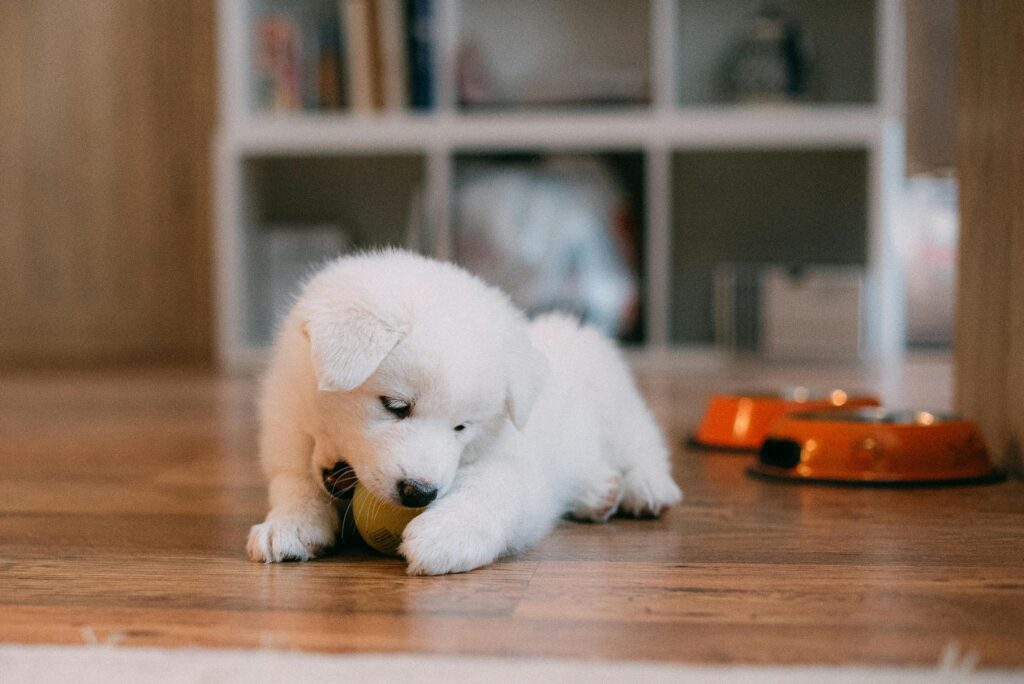
Training puppies requires patience, lots of repetition, and a lot of time to succeed. It can be tough for pet owners to see if their puppy is making progress when training a puppy. There are no defined lines for learning for any puppy. For instance, one day the puppy may do everything right, then the next day the puppy may do everything wrong, which often leads pet owners to believe that training is not working.
However, what pet owners may not realize is that puppy learning does take place, even if pet owners cannot see it happening. Puppies start to learn about behavior in small increments, long before they can respond reliably to their commands. Recognizing early signs of progress can help build the confidence of pet owners and allow them to adjust their training methods as necessary to help build a long-lasting, obedient relationship with their dog.
Your Puppy Responds Faster Over Time
Another way to recognize that your puppy is learning is to monitor the speed of their response. For example, in the beginning stages of training, there may be a delay in the puppy’s response after hearing the command (this includes looking around, appearing confused, etc.). As the puppy’s learning continues to progress, the delay shortens and results in quicker responses and more confidence after hearing a familiar cue.
It may be easy to get frustrated when it seems like your puppy is taking too long to respond, but after monitoring for a longer duration, you should see a trend of increased speed and confidence when responding to a command. Increased speed and confidence indicate that the puppy has established a much stronger association between command and action in its mind.
Your Puppy Starts Offering Behaviors Without Being Asked
A further indicator of successful training is when the puppy begins to perform the desired action, without being asked. This is called “offering behavior.” An example of this would be a puppy learning the command of “sit.”
Rather than requiring the pet owner to encourage the puppy to act, the puppy displays the action on its own, especially when the owner is trying to encourage or prompt the puppy to perform another action.
When a puppy has learned how to respond to “down” during a quiet period, it is a great example that the puppy has actively tried to learn how to earn attention and/or rewards. Analyzing these “offered behaviors” can also be a strong indicator and demonstration of your puppy’s learning capabilities.
Your Puppy Focuses More During Training Sessions
At the start of their training, puppies are prone to a great number of distractions in their environment, such as sounds, movement around them, and simply being curious. As training continues, while your puppy will not stop being distracted by their environment or everything else around them; however, you may find that your puppy will start to focus on you more for longer periods during training.
There will be more eye contact, they will respond to their name more consistently, and they will pay less attention to random distractions during short training sessions. While you are developing an increasing interest or relevance to your puppy in comparison with their environment, the fact that your puppy is beginning to focus on you, as well as being more responsive, demonstrates that your training method is proving successful.
Your Puppy Recovers Quickly From Distractions
Every puppy will be distracted. The difference is how quickly they recover and get back to their owner after the distraction has occurred. Early in training, if your puppy is distracted by a noise or something moving, or another dog, these distractions may completely break your training session. Your puppy will lose focus and will not return to the training session.
However, once you have been successful with your training, you will likely notice that your puppy has a significantly shorter ‘recovery time’. They may take a second to look away from you, but the second after they look away, they will return their focus to you with little effort. The fact that your puppy has learned how to refocus on you indicates that they are displaying self-control and developing an understanding of the objectives of the training: the behaviour and the action.
Your Puppy Understands Context Better
Generalising is a common problem experienced during puppy training. In other words, it means having the ability to recognise that a given command may have multiple meanings in different environments. One of the best signs that your puppy is progressing is when they begin to learn that the meaning of the command may be the same in more than one place.
For example, when your puppy can ‘sit’ in the kitchen, when they were only able to ‘sit’ in the living room, you have confirmed that they have begun to connect the command to the behaviour of sitting, not just that they were doing so in their living room. This ability to generalise commands will develop over a period of time and will represent one of the most significant milestones of development in your puppy’s training.
Your Puppy Shows Positive Anticipation
Puppies associate positive experiences with training when they are being trained effectively; therefore, they may show excitement and anticipation in association with the start of a training session.
When a puppy sees their owner initiating training, or hears a previously learned cue, they typically demonstrate a sense of alertness by bringing their toy to their owner, approaching them with enthusiasm, and positioning themselves to await instructions.
A puppy’s excitement or eagerness to train demonstrates that training is becoming a predictable and positive part of their daily life, and is therefore not perceived as stressful or confusing. If you have a puppy that anticipates training regularly, you can reasonably expect that they will learn quickly and retain the behaviors that you have trained them to do.
Your Puppy Makes Fewer Repetitive Mistakes
An example of a constructive way to train a puppy would be to train the puppy to stay in a single position. When the puppy has fully developed the ability to stay in one place, you should see a gradual decrease in the occurrence of repeated mistakes when trying to stay in one position. In the beginning, the puppy may have to get up frequently from the stay command. As the puppy improves, they will learn to hold a stay for increasing amounts of time.
It is more important that the number of errors is decreasing, as opposed to the number of times the puppy performs a command correctly. A few errors will occur during training; however, it is expected that training will show steady improvement.
With regard to your puppy’s ability to successfully learn commands, a significant indicator will be the ability to successfully practice in more than one environment beyond the initial training environment.
Your Puppy Responds Better to Mild Distractions
There is a well-known developmental stage for puppies that is associated with responding successfully to training commands regardless of how challenging the environment is. The initial training environment will have minimal distractions; however, with time, puppies will begin to respond to basic commands in environments that have more distractions, such as backyards that have light activity or streets that are quiet.
Being able to train in environments with mild distraction indicates an increased ability for puppies to remain focused and flexible mentally.
Your Puppy Looks to You for Guidance
A positive sign of your puppy’s learning is that he displays behavior toward you when experiencing uncertainty.
This expression may include giving you brief eye contact, tilting his head in your direction, or pausing before reacting to something new.
These behaviors indicate trust and communication. Rather than automatically reacting to every stimulus, your puppy is beginning to recognize that you can provide guidance.
This milestone represents a level of bonding between you and your dog that will lead to a successful training partnership.
Your Puppy Calms Down More Quickly After Excitement
Puppies experience excitement during playtime, walking, and greeting people. During their first few months, it may take them a long time to settle down after experiencing excitement.
With consistent training, your puppy will begin returning to a calmer emotional state much faster than he did previously.
By showing this development of self-control, your puppy is not only learning how to obey commands but also how to exercise emotional control.
The quicker your puppy recovers from excitement, the better prepared he will be for real-life experiences such as visitors and distractions in the environment.
Your Puppy Begins to Generalize Good Behavior
Generalizing means that your puppy understands that positive behaviors are also acceptable in other situations outside the formal training environment.
For example, if your puppy is taught not to jump on people when learning to greet them, he may begin to respond with more calmness when visitors arrive.
Or if your puppy practices sitting before dinner, he may start sitting at other times without being told to do so.
This ability to apply what you have taught him into his daily routine is one of the strongest signs of true learning.
It indicates that your puppy is beginning to develop the ability to behave according to his instincts and that the training you provide him will become a part of his behavior.
Your Puppy Shows Willingness to Repeat Behaviors
A puppy that learns well will exhibit behaviors that previously provided pleasant results less frequently.
When your puppy experiences success in the form of being rewarded with praise or attention by sitting or being rewarded by coming when called with either playtime or love, they are likely going to be more likely to repeat those same actions in similar situations in the future.
These repetitions show your puppy understands the relationship between actions and the consequences, so your puppy has a choice regarding the actions that result in positive reinforcement.
Your Puppy Handles Short Training Sessions With Ease
When you are beginning to train your puppy, there may be chaotic or out-of-control training sessions that are short, and puppies will focus on the immediate results, which means puppies commonly become overly enthusiastic when they train.
If your dog starts to become more successful at training, they will begin to handle training sessions more in an organized manner; they will stay focused longer and respond more reliably, and they will recover from distractions more easily between exercises.
This does not mean your puppy will be ready for lengthy training sessions, but it does show their ability to learn increases.
Conclusion
Observing the signs that lead to your puppy learning the correct way to respond to specific commands is very much a vital step in your puppy’s overall training. Each positive learning experience will have positive effects on your puppy’s utilisation of their innate ability to focus and respond more quickly in training; this will be indicative of their growing willingness to continually interact with you in the training process.
Just as with every other aspect of your puppy’s training progress, it is critical to continue with consistent training through patience and positive reinforcements with the desired signs of learning leading to developing reliable and trusting perpetual partnerships between your puppy and yourself.