
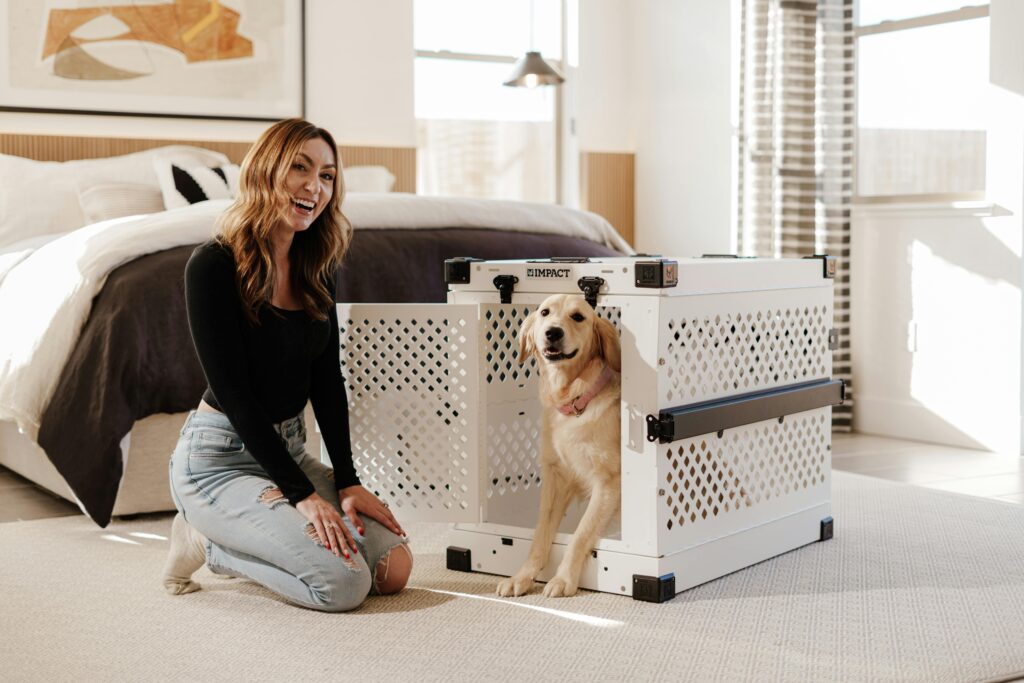
Crate training is one of the earliest and most essential pieces of advice for all new puppy owners. While there are many fun aspects of raising a puppy, there will also be some challenges. Crate training (when done correctly) helps provide puppies with an emotional sense of security, which in turn greatly aids in house breaking; helps minimise undesirable behaviors such as chewing; and provides a peaceful place for your puppy to rest.
Many new puppy owners have concerns about the use of crates. They see them as confining or “cage-like.” However, dogs are natural animals. As a result, they instinctively look for a smaller den-like area to rest in. This is exactly what a crate does – it provides your puppy’s own private “den” to retreat into. So long as you follow proper techniques, a crate will become your puppy’s sanctuary, not a way to punish him/her.
The following information will serve as a starting point for understanding how to successfully crate train your puppy. This includes selecting the correct size of crate, introducing the crate to your puppy at the right time, avoiding common mistakes, and dealing with common issues during crate training.
What Is Crate Training?
Crate training is the process by which a puppy learns to stay calm and relaxed while confined to a crate or kennel. The crate acts as a secure environment in which the puppy can sleep, rest or relax quietly.
Dogs are naturally inclined to want to keep their resting areas clean. Therefore, crate training is particularly effective when potty-training. Crate training can help eliminate unwanted accidents, limit access to potentially hazardous items, aid in protecting home furnishings, and allow puppies to remain safe when unsupervised.
Choosing the right crate
Your choice of crate will be the foundation upon which you’ll base all other steps. Your puppy’s crate cannot be either too big (to avoid accidents) or too small (to limit the ability of your puppy to move).
Crate Size
In terms of size, your puppy should be able to stand up straight, turn around easily, lie down fully stretched out and sit without hitting its head against the top. On the other hand, there must be no excessive space that would lead the puppy to think he could use one end as a restroom area and the other as a bedroom, which would significantly slow down the potty-training process.
Growing Puppies do well in adjustable wire Crates with divider panels. These Types of Crates grow along with your puppy and become progressively larger as your puppy grows.
Types of Puppy Crates
Wire Crates provide the greatest amount of air circulation/visibility, and are typically collapsible with divider panels included. Plastic Crates are more private, and will help some anxious Puppies feel safer while travelling. Soft-sided Crates are portable and lightweight, but are generally better suited for relaxed Puppies rather than those who are hardcore chewers. Furniture style Crates blend in with home decor; they may not be ideal for training younger Puppies.
Some items to consider when selecting a crate are secure latch doors, easy clean-up trays, good air flow, durability, and, if needed, portability.
Preparing the Crate
Before introducing your puppy to the crate, prepare it with soft bedding or a washable crate mat. If your puppy is an aggressive chewer, use simple bedding until they stop chewing on everything.
Use chew toys and puzzle toys to create positive associations
Positive associations with the crate will be created through the use of high value treats, providing meals near or within the crate, and through the addition of favorite toys. Also, shorter crate sessions will greatly increase the likelihood of successful crate training.
Place the crate in a location that the family spends time together, i.e., the living room. Puppies tend to feel more secure when they’re near their pack members. In the initial weeks of training, many owners place their puppy’s crate next to their bed at night in order to assist with reduced anxiety during the night and increased ease of nighttime potty breaks.
Crate Training Process
When crate training is done properly, it will be gradual and positive. Allow your puppy to enter the crate under her own free will by leaving the crate door open. Throw treats inside of the crate for your puppy to retrieve. Never force a puppy into a crate. The ultimate goal is to get your puppy to associate the crate with feelings of comfort and security.
Give your puppy a treat, praise her calmly, or give her a toy each time she enters the crate willingly. Providing meal times near or within the crate will further increase positive associations.
Initially start by letting your puppy be inside the crate for very short periods while you are still near. An example of how you might proceed could be 5-15 minute intervals while sitting next to the crate before allowing them to nap and eventually increasing the length of time spent inside the crate.
After your puppy is comfortable going inside the crate and closing the door for a few seconds while standing beside it, you can slowly phase out being right next to the crate.
Crate Training at Night
Take your puppy outside to go potty at least once before bedtime. Return him to his crate when finished. Do not engage in play activities with your puppy at night since they promote alertness.
Common Crate Training Mistakes
Most issues associated with crate training occur due to inconsistency in routine or unrealistically high expectations from both the owner and dog.
Never punish a puppy by placing them in a crate. This creates a negative association for the puppy with being placed in the crate. Young Puppies should not spend excessive amounts of time inside the crate as they lack bladder control and have high social requirements. As a general rule for daytime, Puppies aged 2-3 months can only manage about 1 hour; older Puppies can gradually take longer stretches.
Additionally, most Puppies require regular bathroom breaks throughout the day, particularly after meals, drinks, sleep, and playtime. While some Puppies adjust quickly, others need additional time; thus, rushing the process may produce stress and whining in your puppy.
How Long Can Puppies Stay in a Crate?
While Crates serve as tools for training, they were never intended as permanent enclosures. Puppies require daily exercise, supervision, socialization and bathroom breaks.
One widely accepted guideline for determining how much time a puppy can safely spend inside its crate is based on 1 hour per month of age. Therefore, a 2-month-old puppy may manage 2 hours; a 4-month-old puppy may manage 4 hours. Older dogs should not be left crated for extended periods each day.
Solving Common Crate Training Problems
Puppy Crying and Whining
Occasionally, whining or crying is acceptable during transition. First check that your puppy doesn’t need to relieve himself, isn’t hungry, and hasn’t over exercised/mentally stimulated enough.
Do not open the crate instantly while your puppy is whining/crying. Instead, delay slightly until he remains calm before releasing him from the crate.
Refusing to Enter the Crate
Create an incentive for entering by using higher-value treats, feeding meals inside, providing preferred toys, and limiting crate session lengths.
Accidents Inside the Crate
If you consistently experience accidents occurring inside the crate, possibly the crate is too large or potty breaks are happening less frequently than necessary. Carefully clean accidents using enzyme-based cleaners. Monitor food/water consumption regularly.
Tips for Successful Crate Training
Establish a consistent schedule/routine for crate training. Provide adequate physical activity before confining to a crate. Above all else – be patient – each puppy will learn at their own rate.
Conclusion
Teaching your puppy crate training can be one of the most important skills you can teach them. With correct introduction to crate training, your puppy will view the crate as both a safe place for sleeping or resting and a space to support in helping with housebreaking. Crate training also provides an additional layer of safety when you are not able to supervise your puppy.
A great way to ensure successful crate training is through being patient, consistent and providing a lot of positive reinforcement. It is crucial to avoid using the crate as a form of punishment and to gradually introduce new items or toys while crate training. By doing this, it creates a very positive experience for your puppy. Most puppies will adapt well to crate training and learn to enjoy time spent in their crates, and develop good habits they will carry over into adulthood.
Related reading: Best Daily Routine for Dogs, How to Fix Inconsistent Puppy Training Progress, Crate Training a Puppy: Complete Beginner Guide