
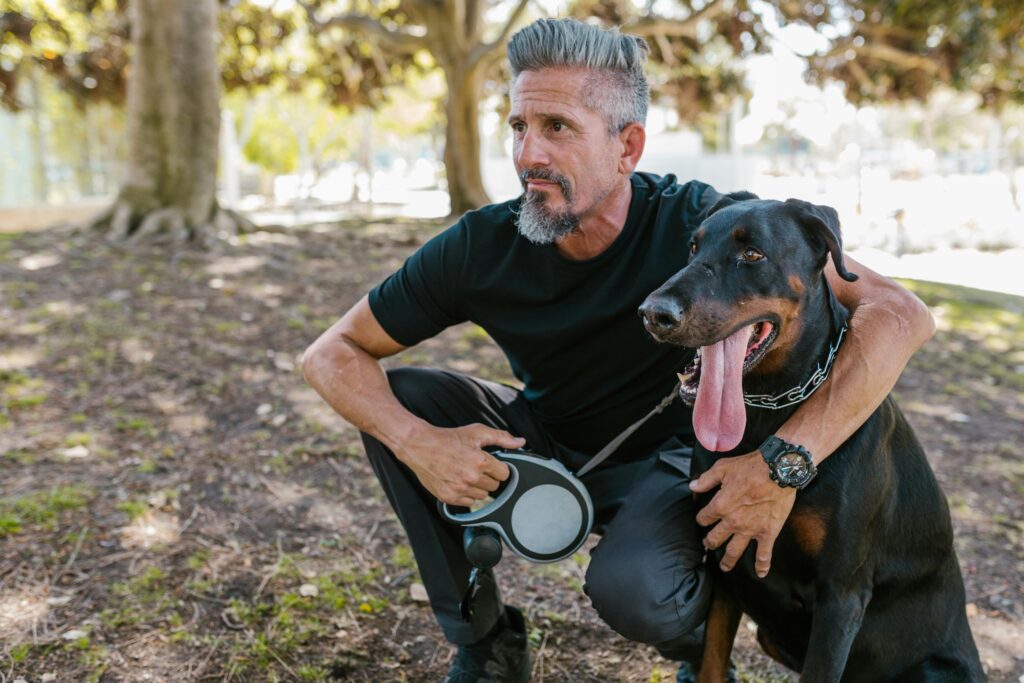
The Doberman Pinscher is one of the most distinctive dog breeds because of its intelligence, athleticism, and both physical and mental abilities. Being bred as a working/protective dog, the Doberman Pinscher has developed into an excellent family pet that will thrive in a family environment with proper training and socialization.
This breed does not do well in homes with passive owners, and their personality is complex, sensitive, and very responsive to their owner and environment. It is important to understand Doberman behavior before bringing one into your home because they are not only physically powerful but also emotionally intelligent and mentally quick. Thus, a Doberman is easily trained and yet very demanding at the same time.
Core Personality Overview
The Doberman Pinscher is a highly intelligent, loyal, alert, and very much a “people dog”. They form strong attachments to their owners and family members, unlike some of the other breeds that are independent in nature.
Most Dobermans desire to be close to their human families. A well-raised Doberman will generally have a calm, directed, and controlled disposition. Conversely, a poorly-raised Doberman may show signs of anxiety, reactivity, overly protective, or aggressive behaviour. In addition to genetics, a Doberman is also strongly influenced by the environment; therefore, early socialization and training are critical components in establishing long-term behavior.
Intelligence and Learning Ability
A major characteristic of the Doberman breed is their level of intelligence, making them an excellent learner. They can learn and perform complicated commands, follow set routines, and meet expected behaviors quickly compared to many other breeds. When there is consistency in the trainer’s use of the command and a good structure to the training program, the dogs are very responsive to the training provided.
The breed has also been known to develop patterns very quickly and, in many cases, can predict what their person is going to command them to do next. With the intelligence of the Doberman breed, they will require assistance in being entertained through mental stimulation. If there is insufficient mental stimulation, it is very likely that the dog will become disinterested, restless, and/or develop poor habits such as excessive barking and pacing.
Loyalty and Attachment to Owners
Doberman dogs develop strong attachments to their people. They are not generally thought of as independent dogs; in fact, the majority of them like to remain near their main human caregiver.
That loyalty has great value in training, as Dobermans are naturally attentive and cooperative. Conversely, that loyalty can lead to emotional dependency if they are not encouraged to feel okay with being alone. A few Dobermans will follow their owner from one room to another and may express distress when away from their owner for an extended period of time.
Protective Instincts
The Doberman is highly regarded for its ability to provide protection. They are generally very vigilant and will observe their environment closely. As a result of being observant of their environment, a well-trained Doberman will evaluate the situation before acting and will often look to their owner for direction on how to respond.
A Doberman that has not had the proper amount of socialization may develop an inappropriate level of protective behavior and can exhibit symptoms of over-protectiveness or become reactive to individuals that they are not familiar with.
Providing a Doberman with a variety of experiences with people, places, and situations on an ongoing basis will assist in maintaining a balance between the protective instinct of the Doberman and their positive behaviours.
Energy Levels and Activity Needs
High-energy dogs like Dobermans need consistent physical activity to stay healthy. Because they are so active, taking a daily walk isn’t enough for them; they’re also able to engage themselves through agility work, training, running, and other mentally stimulating activities.
Without proper management of their high energy levels, they may develop destructive or hyperactive behaviors. A tired Doberman tends to behave much more calmly than one that has not had its energy expended.
Sensitivity and Emotional Awareness
While Dobermans may seem tough on the outside, they are actually quite sensitive. They are very attentive to their owners’ screaming, emotional energy in the house, and body language. They do best under calm, consistent, and justified leadership. Because Doberman dogs are the most emotionally sensitive dogs, they will also sense the stress or tension in the household, which will affect how they behave in any situation.
Social Behavior With People
The Doberman typically demonstrates friendliness and affection to its family members. Dobermans enjoy interaction and will actively seek out closeness and attention. When interacting with unfamiliar people or animals, the behavior of the Doberman can vary according to how well-trained and socialized it is before encountering the unfamiliar entity. Some Dobermans will act withdrawn or hesitant upon meeting a stranger, while others may respond more openly.
In order to stay balanced and confident in different social environments throughout their life, Dobermans require socialization beginning at an early age. If a Doberman is not socially trained early in its life, it may become very suspicious or protective of its owner(s).
Behavior With Other Animals
When introduced in the right way, Dobermans can get along well with other dogs and pets. However, if dominance issues are not dealt with early on due to the Doberman’s confident and dominant nature, there will be issues between the two. Structured introductions are generally preferred, along with consistent boundaries.
How well a Doberman interacts with another animal will depend on how well it has been socialized as a young puppy. Some Dobermans exhibit a strong prey drive, and this must be taken into account when introducing small pets to them.
Trainability and Obedience
The Doberman is one of the most readily trained breeds of dog. A Doberman will respond quickly and positively to commands and loves learning through structured systems. The Doberman is very adept at all types of obedience training, protection, agility, and advanced training.
A Doberman is also very intelligent and learns to follow complex instructions very rapidly. A Doberman must be trained using consistent techniques, as mixed messages or inconsistent rules can confuse the Doberman and lead to the dog testing the boundaries you have established. This breed responds best to positive reinforcement in training, along with clear guidelines.
Common Behavioral Challenges
Dobermans are famous for having so many great characteristics; however, these characteristics can become very bad if you don’t train your dog well. One of the most common negative behaviors seen in Dobermans is separation anxiety. Dobermans create a very close connection to their humans, so they can be very stressed out if they are left alone for too long.
Another negative trait that can be developed in Dobermans, mainly if they are not well-socialized, is being overly protective. This can lead to excessive barking or other indications of being alert in excess of normal levels.
Finally, you must provide your Doberman with plenty of physical and mental activity; they might develop behaviors due to boredom that lead to destruction or barking.
Living Environment Suitability
Dopey has a good chance of being successful if he has surroundings that allow him to get enough socialization, have a structured lifestyle, and have the opportunity to engage in regular activities. Dobermans do poorly in homes where there is little or no activity or where their owners do not have the time to give them enough exercise or training.
Doberman Pinschers can live in apartments or homes as long as they are provided with the opportunity for physical activity on a regular basis. In order to help Doberman Pinschers have balanced behavior, it is important to maintain a regular structure for daily activities.
Ideal Owner Profile
Dog owners tend to be physically fit and knowledgeable about dog training, whether from experience or a desire to learn how to train. They will rely on the dog’s behaviour for their authority, and they must set suitable limits to help the dog establish trust in them. The best Doberman owners are confident, capable, calm, and involved in developing the dog’s well-being.
Conclusion
The Doberman is a highly intelligent, loyal, and powerful breed with a strong emotional connection to its owners. Their personality combines confidence, sensitivity, and a natural protective instinct, making them both impressive companions and serious responsibilities.
When raised in a structured environment with proper training and socialization, Dobermans become calm, obedient, and affectionate dogs. However, without guidance and stimulation, they can develop behavioral challenges related to anxiety, boredom, or overprotectiveness.
Understanding their personality is key to success. The Doberman is not a casual pet, but for the right owner, they are one of the most loyal and capable canine companions available.
Related reading: Shih Tzu Grooming Needs and Maintenance Guide, Golden Retriever Breed Guide, Best Dog Breeds for Families