
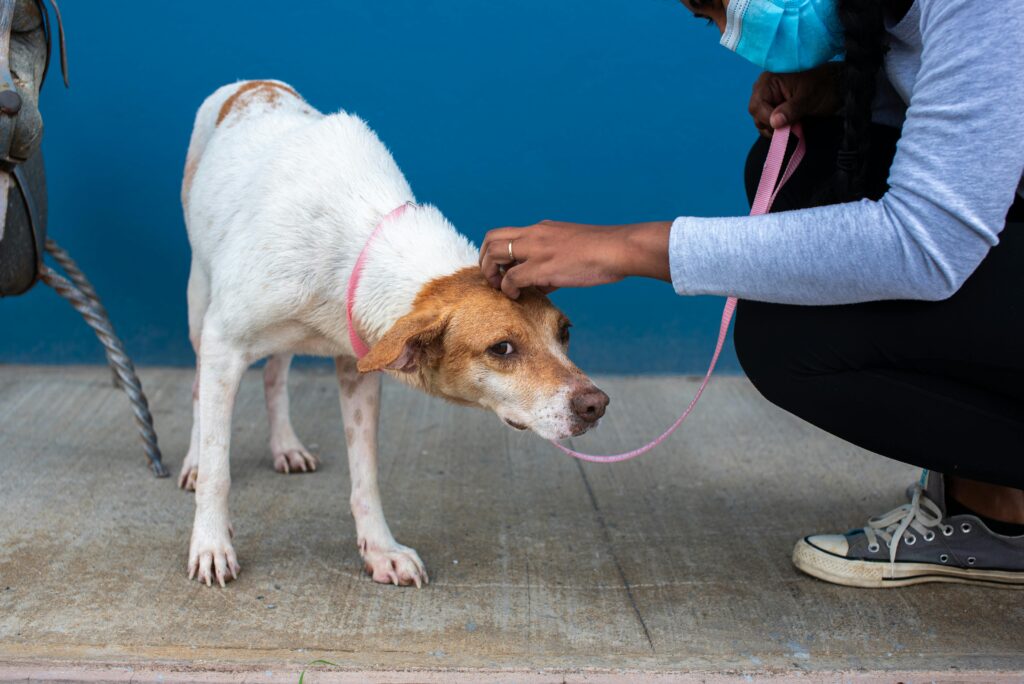
A lot of pet owners are unaware of how widespread fearful behavior in dogs really is. While some dogs may be naturally timid, other dogs will become fearful based on what they have experienced, where they live, or a lack of socialization from birth to maturity.
A fearful dog might avoid you, freeze when you approach them, tremble, etc. It’s vital to understand that fear in dogs is a learned behavior which means the fearful behavior has nothing to do with disobedience. Rather, the fearful behavior is about safety, protection and survival. Therefore, punishing or pressuring a fearful dog typically worsens the condition; it doesn’t improve it.
As well as understanding fear in dogs, it is equally crucial to recognize the differences between fear and aggression. While all fearful dogs are necessarily aggressive, fear can cause defensive behaviors if a fearful dog feels overwhelmed. Aggression is frequently a secondary reaction to fear. To help your fearful dog, you’ll need to work patiently and positively at developing gradual confidence over time through structured interactions.
Causes of Fearful Behavior
Multiple factors could result in a fearful behavior. Frequently, more than one factor exists.
Lack of Socialization
A dog that was not adequately introduced to people, other animals, sounds and environments early in life will likely find most unknown situations frightening or overwhelming throughout their life.
Trauma or Abuse
Past negative events, such as physical, sexual, emotional abuse, neglect or frightful events, can create lasting fear responses. Dogs with traumatic backgrounds may respond dramatically to stimuli they associate with previous traumas (for example: specific sounds, objects or human actions).
Loud Noises
Intense noise, sudden noises (fireworks, thunderstorms, construction, buildings blowing up) can cause lifelong noise phobias. Sometimes a single event causes a lifetime of noise avoidance.
Genetics
Some breeds may be naturally more sensitive and cautious due to temperament genetics. These dogs will require additional support time to adjust to new surroundings and environments and to develop confidence.
Signs of Fear in Dogs
Fearful dogs are easily recognizable through their visible body language and behaviors. Identifying these signals early on will help prevent escalations.
Trembling
Many fearful dogs respond with shaking (shivering) of their legs due to extreme stress or fear. This could be from several events, including trips to the vets, during thunderstorms, or just being in an unfamiliar environment.
Hiding
When your fearful dog sees a possible danger, he/she will attempt to flee and/or hide behind some type of object (furniture, chair, etc.) or into an enclosure.
Hiding is a direct indicator that the dog has recognized a potential threat.
Excessive Panting
While panting after a run or playtime at the park is normal for a healthy dog, heavy breathing alone while exercising or experiencing heat is indicative of excessive stress/anxiety. When your fearful dog encounters a trigger, it’s not uncommon for them to take rapid breaths.
Tail Tucked Posture
If you notice your fearful dog walking around with his/her tail down or lower than usual and/or slinking to the ground, it most likely means this fearful dog feels insecure and/or scared. In addition to a lowered posture, fearful dogs may have difficulty maintaining eye contact with others.
Gradually Building Your Dog’s Confidence
Building confidence in a fearful dog takes time. It takes patience, consistency and allowing the dog to get used to new experiences slowly. The focus is not on forcing the dog to be confident, but rather to build confidence over time. Establishing a safe and predictable environment is very important. When there are quiet areas where the dog can rest peacefully, when there is a routine the dog knows what to expect every day, and when there are places where the dog has a safe space to retreat from pressure, the dog will feel more secure. Positive reinforcement training is also very effective. Whenever your dog makes it through a difficult experience calmly, give them a treat, praise and or give them a toy. These types of reward-based training help dogs associate new situations positively and increase confidence in new and potentially stressful environments.
Gradual Exposure and Training
There is no better method for reducing anxiety and fears in dogs than using gradual exposure. This means starting with something that is at a low enough level that it does not overwhelm your dog. If your dog is fearful of people approaching him or her, he or she may first look at people from a comfortable distance and then work his or her way up to being near people.
Another type of training method called counterconditioning can also be used by pairing anxious triggers with rewards (such as treats) or enjoyable playtime. As your dog learns to associate the stimulus (the thing that triggers their fear) with positive experiences instead of fear, they will start to reduce their fearfulness and become more confident.
Confidence-building activities such as obedience training, scent games, puzzle toys, and low-impact agility courses also contribute to increasing your dog’s emotional stability and engaging mentally.
Helpful Training Techniques
There are several specific helpful methods for building the confidence of a fearful dog.
Training Using Counterconditioning
Counterconditioning changes an animal’s emotional reaction to a stimulus (i.e. the trigger) by associating the stimulus with something good. This means that every time the dog hears a scary noise, it gets rewarded. Eventually, the association will shift from “this is scary” to “I get rewarded for hearing this”.
Training Using Desensitization
Desensitization is a process of exposure to a stimulus at a low enough level that produces no fear. The goal is to gradually increase the stimuli over time but maintain a calm demeanor. The result is that the dog adapts to the stimulus and never becomes overwhelmed.
Confidence-Building Through Games
You can use simple, basic game techniques to develop your dog’s confidence and cognitive abilities. These techniques include:
When To Seek Assistance from Professionals
In some instances of fear, there are situations where assistance from professionals will be necessary to provide a safe way to work through the fear and achieve success.
Cases Of Severe Anxiety
Dogs who have an extreme fear response may find themselves unable to perform normally. These animals often become panicked quickly, either refusing to budge or displaying obvious signs of stress.
A professional can assist you in developing a structured behavior modification program designed to aid in working through your fears.
Aggressive Behavior Triggered By Fear
While some fearful dogs simply flee when confronted with a trigger, others may react aggressively. Growling, snarling, snapping, or even biting are all common forms of aggressive behavior exhibited by fearful dogs when they perceive themselves as being trapped or threatened. These cases require expert-level care and control.
Behavioral Self-Destructive Actions
The most serious form of fear and anxiety-based on destructive behavior is self-destructive behavior. Examples of self-destructive behavior include excessive licking, chewing or destruction due to fear or anxiety. Veterinary or behavioral assistance is required to determine if there is a need for medical intervention prior to escalating into additional problems.
Summary
Addressing a fearful dog requires patience, understanding, and consistency. Fear is an emotion that cannot be eliminated through punishment or coercion. To effectively address fear in dogs, it is best to focus on creating a secure environment, fostering trust, and gradually exposing them to new experiences calmly and conscientiously. Each small improvement made should be acknowledged and rewarded, as progress may occur at a slow rate. Many fearful dogs become more confident and emotionally stable with proper support.
Related reading: Common Dog Owner Mistakes, Best Age to Start Puppy Training, Crate Training a Puppy: Complete Beginner Guide