
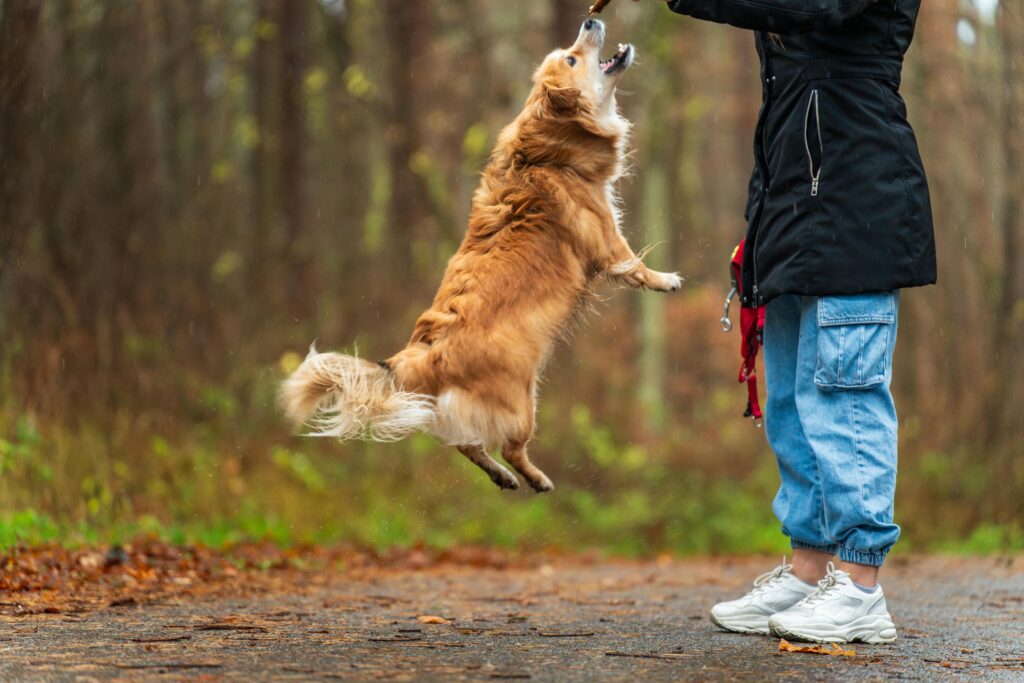
One of the most popular dog behaviors that owners have trouble with is jumping. What may appear as a friendly gesture or as playfulness toward humans can be both troublesome and unsafe, particularly with larger dogs or those who exhibit extreme enthusiasm.
Most often, dogs’ reasons for jumping include greeting others face-to-face (people), seeking human attention, and releasing pent-up excitement. In many instances, jumping begins as a normal puppy behavior which, over time, becomes reinforced and transforms into a bad habit in adulthood.
Early correction of this behavior is essential. As cute as puppy jumping appears, it can become problematic and potentially detrimental in an adult dog without adequate instruction. To address this issue, the goal should always be to replace the unwanted jumping behavior with acceptable manners by teaching your dog how to greet calmly and respectfully.
Why Do Dogs Jump?
Identifying the underlying cause of a dog’s jumping behavior is crucial in developing a training plan. In most situations, a dog does not exhibit aggressive behavior when he jumps up. A majority of times, his behavior is based on excitement or learning through experience.
Excitement
A lot of dogs jump due to their genuine excitement at seeing you and/or other people. Many owners report experiencing this type of excitement from their dogs when they return home or when friends come to visit. This excitement causes the dog’s energy levels to rise dramatically, and jumping becomes an automatic response for him to let off all that extra energy.
Attention Seeking
In addition to being excited about the presence of another person, a lot of dogs also find out that jumping creates a reaction. Sometimes these reactions are physical (pushing the dog away), while at other times the owner might say “no”. However, either way, the owner has provided the dog with attention, and this has allowed the undesirable behavior to continue.
Greeting Behavior
It is also possible that some dogs just naturally want to engage with another individual on a face-to-face basis as part of their social interaction. While this is perfectly fine within their own species, it is not suitable in our society. Therefore, we need to instruct our dogs in alternative ways to interact.
Lack of Training
As previously stated, the primary reason that dogs do not know how to properly greet individuals is due to a lack of education/training. If no boundaries are established, then dogs will continue to perform whatever behavior allows them to receive an emotional reaction from their owners. Consistency is critical in both preventing and resolving a behavioral problem such as jumping.
How to Teach Proper Greetings
Training a dog to greet people calmly requires patience, repetition, and consistency. The goal is to replace jumping with calm behavior that is rewarded.
Ignoring jumping behavior
One of the easiest ways to train your dog to greet people calmly is to simply ignore their jumping.
What this means is:
- You don’t make eye contact
- You don’t talk
- You don’t touch them
You walk away from your dog until both front and hind legs are firmly on the floor. Then you give them attention. This shows your dog that jumping gets no reaction; calmness gets reactions.
Rewarding Calm Sitting
You must reward your dog’s behavior. The moment your dog stops jumping and begins to sit quietly, you should praise him/her or provide a treat. Timing is everything. The reward should occur instantly upon the dog making the right decision.
At first, your dog may think that sitting calmly is just about being quiet because people pay less attention to her/him. But over time, your dog will understand that calmly sitting is the preferred method of greeting.
Consistent training from all visitors
Training your dog to greet visitors calmly needs to be done consistently with every person your dog comes into contact with. Everyone who visits your dog should follow these steps:
- Do nothing when your dog jumps. Ignore him/her completely.
- Congratulate/reinforce your dog as soon as he/she remains calm.
- Avoid physically pushing or yelling at your dog.
If some people let your dog jump while other people do not, it will confuse your dog, and she/he will continue to exhibit the unwanted jumping behavior.
Using Leash Control During Greetings
In addition to ignoring jumping, you could also use a leash to help control your dog’s behavior during training sessions, particularly with excitable or large dogs. As new visitors arrive, keep your dog on a short leash. As soon as the visitor arrives and your dog attempts to jump, slowly pull them back to the ground and immediately reinforce calm behavior after they settle down. This approach prevents repeated rehearsals of the undesired jumping behavior.
Training Commands That Help
Learning basic obedience commands will assist you in providing structure and managing greeting behavior.
Sit
“Sit” is likely one of the most successful tools used in helping to reduce or eliminate unwanted jumping. Before greeting each visitor, ask your dog to sit. Consistently reinforce calm sitting behavior so that it becomes second nature for your dog to remain seated when someone approaches.
Stay
“Stay” gives you greater control over where your dog remains during greetings. Begin with small increments of time (e.g., 30 seconds) and progressively extend the length of time as the dog gains proficiency. It is particularly helpful when guests enter the house.
Place Command
The “place” command instructs your dog to move to a designated location, e.g., a bed or mat and remain there. This is a good option for helping to regulate excessive enthusiasm during visitations and for replacing undesirable jumping behaviors with more acceptable ones.
Mistakes Owners Make
Owners commonly make some mistakes which could encourage jumping behavior rather than discouraging it.
Encouraging Dog to Jump
Several owners unknowingly (accidentally) reinforce the jumping behavior through:
- Petting the dog upon their jumping
- Talking excitedly
- Pushing the dog and laughing
- Giving attention immediately after the dog’s jump
Even if owners react negatively toward the dog’s jumping, these negative reactions still may feel like rewards to the excited dog.
Inconsistencies In Rules
If jumping is permitted at times but discouraged at other times, then the dog will not know what to do. Consistent rules in all situations are required for effective training.
Punishing After the Fact
There is no method of teaching the proper behavior by punishing the dog for jumping after the fact. The dog may not associate the punishment with the action. Instead, reward calm behavior as you see it happening.
Tips for Puppies vs Adult Dogs
As mentioned previously, there are differences in how one trains based on the puppy versus adult dog, as well as varying levels of energy and physical ability. Early Training Methods For Puppies
Puppies learn rapidly; therefore, puppies need early training focused on preventing jumping behavior. Key factors to prevent include:
- Rewarding your puppy for remaining calm during greeting interactions
- Avoiding playful interaction with your puppy that causes them to jump
- Teach ‘sit’ to your puppy before allowing them to receive attention. Consistency
- During puppy development, it prevents long-term habits.
Managing Stronger Adult Dogs
Adult dogs that already exhibit jumping behaviors require more structure in their training. Helpful approaches to use for this type of dog include:
- Leash control of your adult dog during greeting interactions
- Practicing calm behaviour with your adult dog in low distraction areas
- Repeated reinforcement of your adult dog sitting before receiving attention
- Gradually exposing your adult dog to various types of visitors and excitement triggers. With consistent application of these principles, most established habits can be modified.
Conclusion
While a natural behavior for dogs, excessive jumping on people can be controlled with a few simple changes in training. Most dogs jump due to excitement, attention-seeking or lack of education about alternative ways to interact. Successful training relies heavily on consistency, patience and providing positive reinforcement for calm greetings. Ignoring undesirable behavior, positively reinforcing the act of sitting, and implementing clear commands assist the transition from undesirable to desirable behavior. Through continued practice and application of these techniques, dogs develop an understanding that calm behavior is the best method for greeting individuals.