
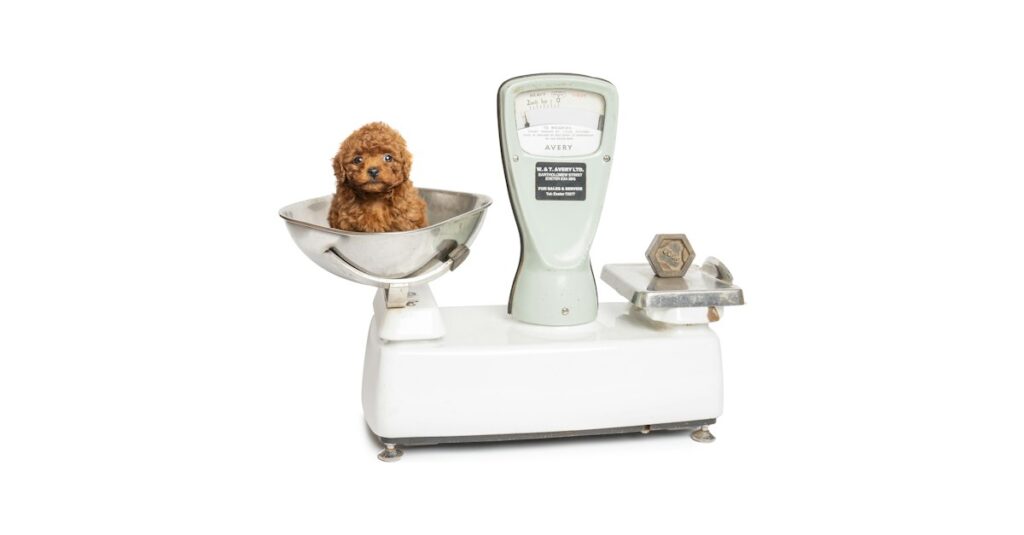
This puppy weight calculator tells you how large your dog will be as an adult. Enter your puppy’s age and its current weight and this tool will tell you your puppy’s adult weight, provide you with a probable range of weights, estimate how much growing is left, and give you a chart showing your puppy’s growth from approximately two months to eighteen months old.
The puppy weight calculator can work on both purebred and mixed-breed puppies in either pounds or kilograms. The benefits of knowing how heavy your puppy is going to get include making informed decisions such as which size crate to purchase, how much food to give them, and when you’ll have to replace the harness.
Puppy Weight Calculator
Enter today’s weight and age. Pick a breed or size if you know it, or leave it on “Not sure” for mixed breeds.
Works for puppies from 6 weeks to 24 months. This is an estimate, not a diagnosis. Your vet can check growth against your puppy’s body condition.
How to Use the Puppy Weight Calculator
- Weigh your puppy today. For small pups, step on a bathroom scale holding the puppy, then subtract your own weight.
- Enter the weight and choose pounds or kilograms.
- Enter the age in weeks or months. Weeks are more accurate for puppies under six months.
- Pick the breed if it is listed. For a mix or an unknown rescue, leave the size on “Not sure”.
- Press Calculate to see the adult weight estimate, the range, and the growth chart.
Re-check the weight every two to three weeks. One weigh-in represents a momentary snapshot, and puppies grow in fits and starts. Several weigh-ins taken over time that all point to the same adult weight are much more reliable than just one measurement.
How the Dog Weight Calculator Works
The majority of online tools use the “weight divided by age in weeks x 52” formula to calculate adult size. The idea behind this formula is that each puppy grows the exact same amount per week for a whole year. No such thing occurs. The growth rate of puppies is high during the first few months and then declines with each passing month, and a Chihuahua is fully grown months before a Great Dane.
This dog size calculator uses growth curves instead. The growth curves are specific to each size range and show the percent of adult weight that a typical puppy has reached by each age. The tool locates your puppy’s position along the appropriate growth curve and scales up. If you select “Not sure”, the puppy is tested against all size ranges. In cases where a puppy sits between two of them, such as medium and large, the tool blends the two closest together, so there is no jumping from one answer to another.
| Age | Toy | Small | Medium | Large | Giant |
|---|---|---|---|---|---|
| 8 weeks | 33% | 29% | 22% | 17% | 12% |
| 12 weeks | 47% | 42% | 33% | 27% | 21% |
| 16 weeks | 60% | 54% | 44% | 38% | 31% |
| 6 months | 82% | 76% | 66% | 61% | 52% |
| 9 months | 95% | 92% | 86% | 80% | 72% |
| 12 months | 100% | 99% | 96% | 91% | 85% |
| 18 months | 100% | 100% | 100% | 100% | 97% |
Those curves were created using published growth data, including the American Kennel Club’s growth percentages by size and a growth study of puppies from toy to giant breeds in The Journal of Nutrition. That study found that small and medium-sized puppies reached half their adult body weight at approximately 4 months old, while large and giant-sized puppies took almost 5 months to reach half their adult body weight.
Puppy Growth Chart: When Do Puppies Stop Growing?
| Breed size | Adult weight | Half grown at | Full weight at | Examples |
|---|---|---|---|---|
| Toy | Under 12 lb | About 3 months | 8 to 10 months | Chihuahua, Yorkshire Terrier, Toy Poodle |
| Small | 12 to 25 lb | 3 to 4 months | 10 to 12 months | Shih Tzu, French Bulldog, Cavapoo |
| Medium | 25 to 55 lb | About 4 months | 12 to 15 months | Beagle, Border Collie, Siberian Husky |
| Large | 55 to 100 lb | About 5 months | 15 to 18 months | Labrador, Golden Retriever, German Shepherd |
| Giant | Over 100 lb | 5 to 6 months | 18 to 24 months | Great Dane, Mastiff, Saint Bernard |
Height generally finishes before weight. A large-breed dog will typically reach its final height at around one year of age and then fill out through the chest and shoulders for about six more months. That is why it is normal for a ten-month-old Lab to look lanky.
How Accurate Is a Puppy Weight Calculator?
The accuracy of a prediction is based primarily upon the puppy’s age. Before ten weeks of age, a few ounces either way moves the prediction a lot, so treat the result as a very broad range. At about sixteen weeks of age the estimate becomes tighter, and by six months most puppies will fall within 10% of their estimated adult weight.
- Under 10 weeks: expect the real adult weight within about 25% of the estimate.
- 10 to 16 weeks: within about 20%.
- 4 to 6 months: within about 15%.
- Over 6 months: within about 10%.
There are many factors involved in determining how big your mixed-breed pup will grow; as a result, predicting adult weight for this type of pet can be difficult. A puppy can take after either of its parents, so if you know the weight of each parent, those weights give you reasonable lower and upper limits for your puppy’s adult weight. The size of a puppy’s paws is also a poor indicator of eventual adult weight; plenty of pups with large paws grow into medium-sized adult dogs.
Is My Puppy Growing on Track?
What is important to assess is the body shape of your puppy. The number on the scale matters, but body condition matters more. You want to be able to feel the ribcage easily through a thin layer of fat, and you should be able to see a waist when you look at your puppy from directly above. If the ribs are very difficult to locate, your puppy is carrying too much body fat. Conversely, if you can clearly see the ribs, spine and hip bones, then your puppy likely needs more calories or veterinary attention.
Faster is not better, least of all when you’re dealing with large or giant breeds. Puppies that eat too many calories and grow too quickly increase their chance of having joint and bone problems. Using a puppy food made for large-breed puppies and measuring your puppy’s food will help keep growth at a steady pace. Our puppy feeding schedule calculator works out daily portions from the same age and weight you entered here.
What Changes a Dog’s Adult Size?
- Genetics. The parents’ size is the best single predictor. Ask the breeder or shelter what they know.
- Sex. Males usually finish heavier than females of the same breed, often by 10 to 15 percent.
- Nutrition. Underfeeding can stunt growth. Overfeeding does not make a dog taller, only heavier.
- Spay or neuter timing. Dogs neutered before their growth plates close can end up slightly taller, because the plates stay open longer.
- Health. Heavy worm burdens and illness in the first months can slow growth for a while.
Use the Adult Weight to Buy the Right Gear Once
Predicting what your puppy will weigh as an adult can save you from buying equipment twice. When purchasing a crate, buy the one that fits the adult dog and use a divider to section off part of it while your puppy is small. Collars and harnesses are the opposite: buy them based on how big the puppy is right now. A loose-fitting collar will slip off, and a loose-fitting harness rubs and causes skin irritation.
Next steps: find the right crate with the dog crate sizes chart and calculator, check the dog collar size chart and the dog harness size chart, then set up a daily puppy schedule.
Related Reading
- Puppy Feeding Schedule Guide
- Crate Training a Puppy: Complete Beginner Guide
- Best Puppy Crates for Training
- German Shepherd Puppy Guide
- Best Age to Start Puppy Training
FAQs
How big will my puppy get?
Use the calculator above with your puppy’s current weight and age to get an estimated adult size. As a rough guide, toy and small breeds reach adult weight by 8 to 12 months, medium breeds by 12 to 15 months, and large and giant breeds by 15 to 24 months.
When do puppies stop growing?
Toy and small breed puppies will usually finish growing by their first birthday. Larger breeds will continue to fill out until approximately 18 months of age. Giant breeds, such as Great Danes and Mastiffs, may keep gaining weight until they are 2 years old.
Can you predict a dog’s size from its paws?
Only loosely. Large paws suggest that the adult will be large as well; however, the relationship is weak. A better predictor of the adult dog’s weight is age and current body weight, checked three or four times over a couple of months.
How do I estimate adult weight for a mixed-breed puppy?
Leave the breed field blank and select “Not sure” for the size field. This tells the calculator to compare your puppy against all possible sizes in order to find the most likely adult size. If you know the parents’ weights, expect the adult weight to fall somewhere between them.
How much weight should a puppy gain each week?
It really depends on how big the puppy will be. A small-breed puppy may add about 5 ounces per week. Large-breed puppies can gain 2 pounds or more per week during their fastest growth. The amount gained per week matters less than whether the puppy grows steadily and keeps a defined waistline.
Do male and female puppies end up the same size?
Usually not. In most breeds, males tend to be heavier than females by 10 to 15 percent. Therefore, if your result is at the upper end of the range and your puppy is a female, she will likely come in a bit lower.