
This post contains affiliate links. As an Amazon Associate we earn from qualifying purchases, at no extra cost to you. We only recommend products we’d genuinely put our own dogs in.
The majority of anxious dogs find a crate is similar to an enclosed “den” which may be the safest area from the outside world’s noise, movement and unpredictable environment. When used properly, a crate or appropriate crate and cover combination will likely be one of the best tools available to help manage daily anxiety as well as anxiety related to thunderstorms, fireworks and separation.
Below are our recommended crates and covers for anxious dogs; in addition to their uses, we have included recommendations on how to introduce these items into your dog’s life so that you can maximize their potential for being comforting to your dog instead of stressful.
Our Top Picks
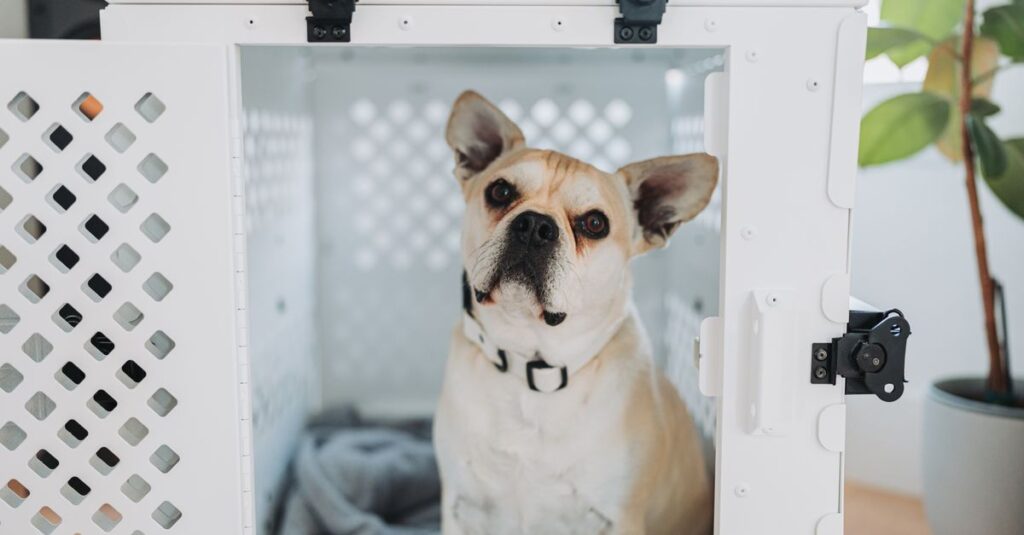
Diggs Revol Collapsible Crate: The Diggs Revol Collapsible Crate is a den-like, solid feeling crate which allows for many anxious dogs to relax in it better than they do in an open wire crate due to the solid-enclosed diamond mesh panels and strong aluminum structure. The calming design of this product will allow it to be kept permanently as a room fixture and not have to be tucked away. View on Amazon →
MidWest Dog Crate Cover (Fits 22-Inch Crates): The MidWest Dog Crate Cover is a simple, well-reviewed dog crate cover. The purpose of this cover is to provide an enclosed space, or what is known as a “den”, in which your dog can retreat when it feels anxious. This den will help to eliminate or at least minimize barking and chewing caused by anxiety. The cover has three openings (for single, double, and triple-door) that have removable flaps so you can adjust the level of ventilation and viewing area. It is also ideal for use on 22-inch wide dog crates because many small breed dogs are housed in these sizes. View on Amazon →
Calming Crate Cover, 30-Inch (Blackout, Anxiety-Focused): Calming crate cover, 30″ blackout, for anxious dogs. This is an extra heavy duty blackout (blocking 95% of all light) crate cover that provides breathability as well as allowing multiple doors to be used at once. The included storage bag makes it easy to take along on travel. View on Amazon →
Choosing the Right Crate Style
Anxious dogs are generally better suited to either solid-walled or partially covered crates as opposed to completely open wire crates, since lessening the amount of visual stimuli from every side of the crate will likely reduce a nervous dog’s overall arousal level. If you want to achieve this den-like feeling in a crate you already own, you can do so by adding a breathable cover to three sides of a wire crate, while leaving one side open for ventilation and a clear sight line out. This is the simplest, most cost-effective way to add this feature without buying a new crate entirely.
For dogs with noise sensitivity specifically, some heavier, more solid crate constructions can modestly dampen sound compared to open wire designs, which may help somewhat during thunderstorms or fireworks, though no standard crate provides true soundproofing.
Introducing the Crate Without Creating More Anxiety
Never force an anxious dog into a crate, or use it as a punishment, since this directly undermines the safe-space association you’re trying to build. Introduce it gradually with the door left open, letting your dog explore entirely at their own pace over days or weeks, scattering treats and favorite toys inside along the way.
Feed meals inside the crate with the door left open at first. Gradually close the door for brief moments during calm times, well before ever expecting an anxious dog to be crated during an actually triggering event, like a thunderstorm.
Using the Crate During Anxiety Triggers
Once your dog has a genuinely positive association with the crate, it can become a self-chosen retreat during stressful moments rather than something you need to enforce. For dogs with more significant anxiety, combining crate use with other supportive measures, calming pheromone diffusers, appropriate anti-anxiety wraps, and background white noise, often produces better results than the crate alone.
A veterinary behaviorist can help design a comprehensive plan for dogs whose anxiety is significant enough to affect their daily quality of life.
Conclusion
Anxious dogs can be given a much safer place to retreat from their environment with a closed-in design like the Diggs Revol, paired with a calming cover like the MidWest or the blackout options above. It’s just as important to do a slow, positive introduction, because no matter how good the crate is, if your dog has associated it with something negative, the crate itself won’t help.
If your dog has separation anxiety or extreme panic responses when left alone, treat the crate as one part of a larger plan built with your veterinarian or a certified animal behaviorist, not a standalone fix.
Related Reading
why anxious dogs shake, why dogs seek closeness when anxious, crate training a puppy overnight, foldable crate options
FAQs
Should I cover my anxious dog’s crate?
Covering a dog crate partially (three sides) and leaving one side open is a way to reduce an anxious dog’s stress from seeing too much around them, while still providing adequate ventilation. This lets owners simply place a towel or sheet across the crate, without spending money, to create some separation between their pet and anything they might find frightening.
Can crate training worsen separation anxiety?
If it’s forced, or if it becomes associated with being left alone before a dog is truly comfortable in the crate, then yes. A positive, slow approach to introducing a crate is very important, and in severe cases there’s more you can do with help from a certified animal behaviorist or your veterinarian.
How do I know if my dog sees the crate as a safe space?
If you see your dog willingly entering the crate when they’re relaxed, rather than needing to be placed there, they likely view it positively, as their own retreat.