
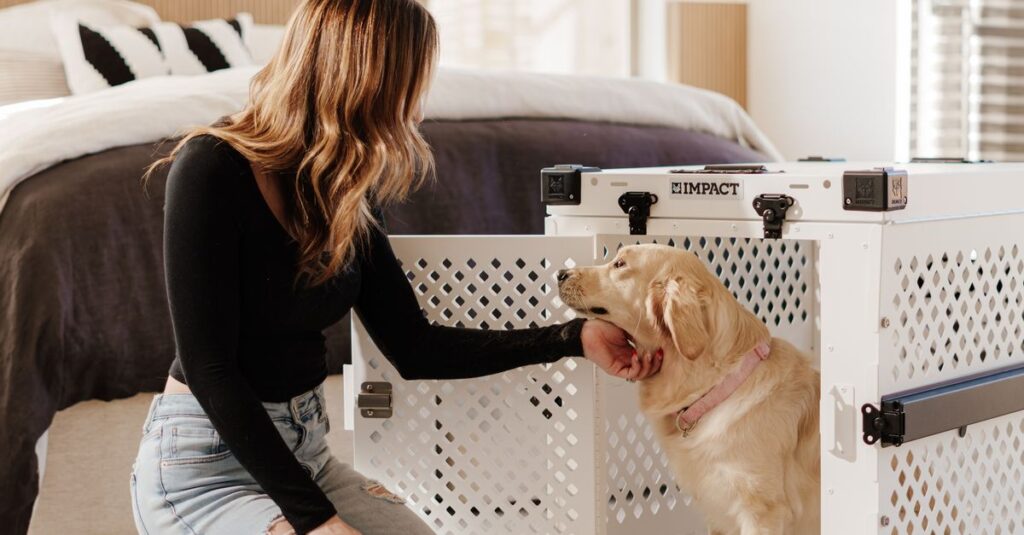
The first few nights with a crate are often the hardest part of puppyhood for owners, since it usually means some interrupted sleep before your new dog settles into the routine. The good news: with a consistent approach, most puppies adapt to sleeping through the night in a crate within one to three weeks, and the payoff, a safely contained, house-trained dog, is well worth the short-term disruption.
The key to success is treating the crate as a cozy, safe place for your puppy to rest rather than a form of confinement or punishment, and building a routine that works with, not against, a young puppy’s small bladder and developing sleep patterns.
Set Up the Crate for Success
Get a crate that lets your puppy stand up, turn around, and lie down comfortably, but not one so big that they can use one end as a bathroom and the other as a bed, since that works against the natural instinct not to soil their sleeping area. Many crates come with dividers so you can expand the space as your puppy grows into their adult size.
Line the crate with something soft and washable, like a blanket, and place it in or near your bedroom for the first several weeks. Keeping the crate close by helps you catch early cues that your puppy needs a bathroom break, and having you nearby provides reassurance that meaningfully reduces nighttime whining while they adjust to being away from their littermates.
Manage the Overnight Bathroom Schedule
A general rule of thumb is that puppies can typically hold their bladder for about one hour per month of age, plus one, up to roughly their bladder capacity as an adult, meaning a two-month-old puppy may need a bathroom break about every three hours overnight. Take your puppy out for a final bathroom trip right before bed, and set an alarm for one or two overnight breaks in the early weeks, rather than hoping they’ll make it through.
Keep these overnight bathroom trips low-key: minimal lighting, no play, no excited chatter. Take them straight outside, let them do their business, offer quiet praise, and return straight to the crate. This teaches your puppy that nighttime bathroom breaks are strictly functional, not playtime, which helps them settle back to sleep quickly instead of treating 3 a.m. as an invitation to party.
Build a Consistent Bedtime Routine
Puppies do well with predictability. A consistent bedtime routine, a final potty break, a short calming activity, then straight into the crate at roughly the same time each night, signals that it’s time to settle down. Avoid feeding or offering large amounts of water in the couple of hours before bed to reduce the odds of an urgent overnight bathroom need.
Some whining or crying in the first few nights is normal as your puppy adjusts to sleeping alone. Resist the urge to let them out simply because they’re crying, since that can teach them crying gets results. Instead, wait for a brief pause in the noise before opening the crate, so you’re rewarding calm rather than protest.
Troubleshooting Common Problems
If your puppy is consistently having accidents overnight despite a reasonable bathroom schedule, double-check that the crate isn’t too large, and that your puppy was genuinely empty before the final bedtime crating. Persistent accidents despite a good schedule are also worth mentioning to your vet, since urinary tract infections can occasionally be a contributing factor in young puppies.
If crying persists well beyond the first couple of weeks, consider whether the crate has become associated with something negative, and work on building positive associations during the day with short, happy crate sessions paired with treats and meals, so nighttime crating feels like an extension of a place your puppy already enjoys.
Signs Your Puppy Is Ready for More Freedom
Once your puppy has gone several consecutive weeks without an overnight accident and settles into the crate calmly without prolonged whining, you can start considering more overnight freedom, like leaving the crate door open within a puppy-proofed bedroom. Introduce this gradually, watching closely for any regression before removing crate confinement entirely.
Every puppy’s timeline differs based on breed, individual temperament, and consistency of training, so resist comparing your dog’s progress too closely to a neighbor’s or a friend’s. A slower, steady path to overnight freedom that avoids setbacks is ultimately faster than repeatedly pushing ahead too soon and having to restart the process.
Choosing the Right Crate Location as Your Puppy Grows
While keeping the crate in your bedroom for the first several weeks helps with bonding and bathroom cues, many owners eventually move it to a different room once their puppy matures and sleeps more reliably through the night. Make this move gradually, perhaps starting with a few nights in a hallway just outside the bedroom before a full transition.
Whatever location you settle on long-term, keep it consistent once established, since dogs generally do best with a predictable, unchanging sleep environment rather than one that moves around the house unpredictably from night to night.
Conclusion
Crate training overnight takes patience and a few disrupted nights of sleep, but a consistent routine of bathroom breaks, a calm bedtime routine, and positive crate associations gets most puppies sleeping through the night within a few weeks. Treat the crate as a safe den, not a punishment, and progress tends to follow naturally.
Every puppy adjusts at their own pace, so focus on steady consistency over speed, and you’ll end up with a dog who genuinely loves their crate for years to come.
Related Reading
foldable crate options, calming crates for anxious puppies, potty pad training
FAQs
How long does overnight crate training usually take?
Most puppies adjust within about one to three weeks, though every dog trains on their own timeline.
Should I ignore my puppy’s crying at night?
Some settling-in whining is normal and okay to let pass. But if your puppy has a genuine need, especially to go to the bathroom, respond promptly. The goal is consistency, not ignoring real needs.
Where should the crate go at night?
It’s generally best to keep the crate near your bed for the first few weeks after bringing your puppy home. This lets you hear their bathroom cues and gives them reassurance as they adjust to sleeping in the crate.