
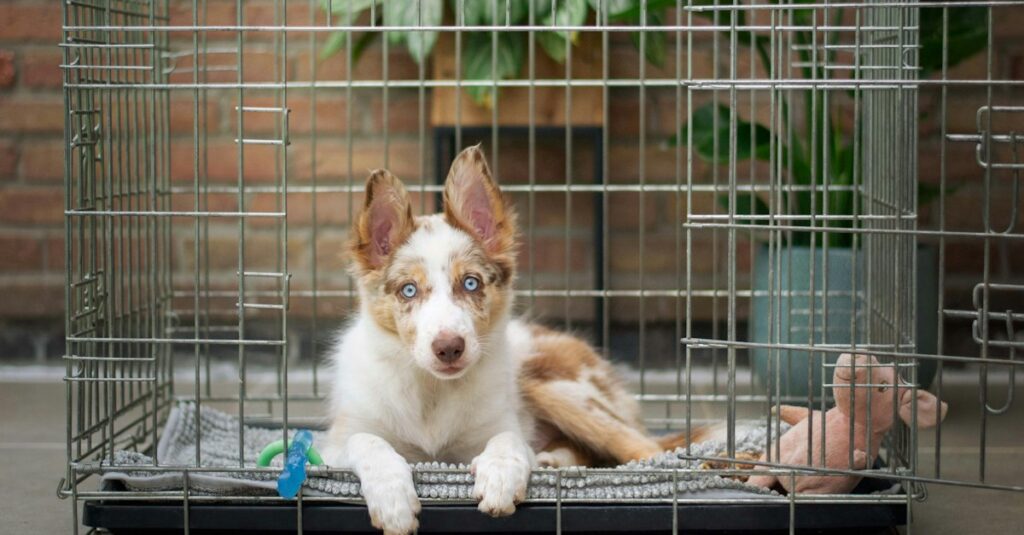
Dog crate sizes run anywhere from 18 inches for small toy breeds to 54 inches for giant breeds, so when choosing a dog crate, you’ll want to look at your dog’s dimensions, its length and height, rather than just its weight. The best way to do this is by using the calculator below to find the correct crate from your dog’s breed, weight or measurements, and then comparing the suggested size with our complete dog crate size chart.
Getting the size right is crucial for both training and comfort. A dog needs room to stand, turn around and stretch out when it is in its crate. If the crate is too small, the puppy will be cramped, and if the crate is too large there will be enough room for the puppy to sleep at one end and do its business at the other, which undermines house training.
Dog Crate Size Calculator
Pick a breed, enter a weight, or type in your dog’s measurements. The more you add, the better the match.
Fill in whatever you know. Measurements beat breed, and breed beats weight. Crate makers differ by an inch or two, so check the inside dimensions before you buy.
Dog Crate Size Chart
| Crate length | Size name | Dog weight | Typical L x W x H | Example breeds |
|---|---|---|---|---|
| 18 in | XXS | Up to 6 lb | 18 x 12 x 14 in | Chihuahua, teacup breeds |
| 22 in | XS | 7 to 12 lb | 22 x 13 x 16 in | Yorkshire Terrier, Maltese, Pomeranian, Toy Poodle |
| 24 in | Small | 13 to 25 lb | 24 x 18 x 19 in | Shih Tzu, Pug, Havanese, Miniature Schnauzer |
| 30 in | Medium | 26 to 40 lb | 30 x 19 x 21 in | Beagle, French Bulldog, Cocker Spaniel, Corgi |
| 36 in | Intermediate | 41 to 60 lb | 36 x 23 x 25 in | Border Collie, Bulldog, Australian Shepherd |
| 42 in | Large | 61 to 90 lb | 42 x 28 x 30 in | Labrador, Golden Retriever, Boxer, Siberian Husky |
| 48 in | XL | 91 to 110 lb | 48 x 30 x 33 in | German Shepherd, Rottweiler, Doberman, Akita |
| 54 in | XXL / Giant | Over 110 lb | 54 x 37 x 45 in | Great Dane, Mastiff, Saint Bernard, Newfoundland |
Use the weight column for reference only. Breeds are placed on this chart based upon how a typical adult dog would fit. That is why a 70 pound Labrador is shown next to 42 inches while a 70 pound German Shepherd is shown next to 48. The Shepherd is taller and longer than the Labrador at the same weight. If your dog’s weight and its measurements conflict, use the measurements.
How to Measure Your Dog for a Crate
- Length. With your dog standing, measure from the tip of the nose to the base of the tail. Leave the tail itself out.
- Height. With your dog sitting upright, measure from the floor to the top of the head, or to the ear tips if the ears stand up. Sitting height is usually the taller of the two positions.
- Add clearance. Add 2 inches for small dogs and up to 4 inches for large dogs to both numbers.
- Match to a crate. Choose the smallest crate whose inside length and height are at least as big as your two totals.
If you can’t get your dog to stay completely still, try measuring along the back while he or she is standing at the food dish eating; or place a piece of painter’s tape on the wall at the tip of the nose and another at the base of the tail as your dog stands next to it, and then measure how far apart the two pieces are. Holding a treat at nose height keeps the head level while you take the height.
Dog Crate Sizes by Breed
| Breed | Adult weight | Crate size |
|---|---|---|
| Australian Shepherd | 40 to 65 lb | 36 in |
| Beagle | 20 to 30 lb | 30 in |
| Bernese Mountain Dog | 70 to 115 lb | 48 in |
| Border Collie | 30 to 55 lb | 36 in |
| Boxer | 50 to 80 lb | 42 in |
| Bulldog (English) | 40 to 50 lb | 36 in |
| Cavapoo | 9 to 25 lb | 30 in |
| Chihuahua | 3 to 6 lb | 18 in |
| Cocker Spaniel | 20 to 30 lb | 30 in |
| Doberman Pinscher | 60 to 100 lb | 48 in |
| French Bulldog | 16 to 28 lb | 30 in |
| German Shepherd | 50 to 90 lb | 48 in |
| Golden Retriever | 55 to 75 lb | 42 in |
| Goldendoodle (standard) | 50 to 90 lb | 42 in |
| Great Dane | 110 to 175 lb | 54 in |
| Labrador Retriever | 55 to 80 lb | 42 in |
| Mastiff | 120 to 230 lb | 54 in |
| Pembroke Welsh Corgi | 22 to 30 lb | 30 in |
| Pug | 14 to 18 lb | 24 in |
| Rottweiler | 80 to 135 lb | 48 in |
| Shih Tzu | 9 to 16 lb | 24 in |
| Siberian Husky | 35 to 60 lb | 42 in |
| Yorkshire Terrier | 4 to 7 lb | 22 in |
What Size Crate for a Puppy?
Buy the crate that your puppy will need when it is grown up. To limit how big the space is for now, you can insert a divider panel. Most wire crates come with a divider. Place the divider so that there is room for your puppy to stand, turn around and lie down, and no more. The open space should be about two to four inches longer than your puppy. Using a divider is less expensive than purchasing two or three crates. It also limits the amount of space available, which is the key to using a crate for potty training.
| Puppy age | What to do with the divider |
|---|---|
| 8 to 12 weeks | Smallest setting. Just enough room to turn around and lie flat. |
| 3 to 4 months | Check every two weeks. Move it back when your puppy cannot stretch out fully. |
| 5 to 7 months | Fast growth for large breeds. Expect to move it every two to three weeks. |
| 8 to 12 months | Small and medium breeds can usually lose the divider. Keep it for large breeds if accidents are still happening. |
| 12 to 18 months | Large and giant breeds reach full length. Remove the divider once the dog is reliably clean overnight. |
Are you unsure about the final adult size of your new puppy? First estimate what the full-grown adult weight will be. Then, once you have that estimate, come back and select the appropriate crate for that size. The puppy weight calculator gives you that number from your puppy’s age and weight today.
Is the Crate Too Small or Too Big?
- Too small: your dog has to duck to stand, cannot turn around without bumping the sides, or sleeps curled up tight because there is no room to stretch.
- Too big: a puppy sleeps at one end and has accidents at the other, or slides around when the crate is in a moving car.
- About right: your dog can stand without the head or ears touching the top, turn in a circle, and lie on one side with legs out.
When your dog is between two different sizes, I would recommend sizing up for an adult dog and filling the excess space with a bed. For puppies in training I would recommend sizing up as well, but using the divider to keep the usable space small. The only time it makes sense to size down is if you plan on traveling with your dog by car; a snugger fit keeps your dog from being thrown around inside the crate during a sudden stop.
Wire, Plastic or Soft Crate: Does Type Change the Size?
The listed size is the outside length of the crate, and the usable space inside will vary based on the style of crate. Wire crates allow for almost all of the listed size to be used as inside space. Plastic kennels are constructed with thicker walls and have a sloping roof, which results in approximately an inch or two less inside space than the listed size would suggest. Furniture-style and heavy-duty crates may lose even more usable space; therefore, it is important to review the interior dimensions in the product details.
| Crate type | Best for | Sizing note |
|---|---|---|
| Wire (folding) | Puppies, crate training, most homes | True to size. Usually includes a divider. |
| Plastic kennel | Travel, dogs that like an enclosed den | Runs snug. Check interior height. |
| Soft-sided | Calm adult dogs, short trips | True to size but not for chewers or puppies. |
| Heavy-duty | Escape artists, strong chewers | Thick frame. Interior can be 2 inches smaller. |
| Furniture style | Living rooms, trained adults | Varies a lot by brand. Measure the inside. |
Flying is a separate case. Most airlines follow the IATA (International Air Transport Association) container rules for shipping dogs; the kennel is sized from four body measurements so your dog has enough room to stand up in it without its ears touching the roof. Look at your airline’s website prior to purchasing a travel kennel, since some airlines add requirements beyond those set by IATA.
Common Crate Sizing Mistakes
- Buying for the puppy’s size today, with no divider, and replacing the crate three times in a year.
- Sizing by weight alone. A Greyhound and a Bulldog can weigh the same and need crates two sizes apart.
- Measuring to the tip of the tail. That adds length the dog does not need and pushes you into a crate that is too big.
- Forgetting ear height on breeds with upright ears, such as German Shepherds and Huskies.
- Putting two dogs in one crate. Each dog needs its own, sized for that dog.
Once the crate is the right size, the next job is making your puppy like it. Start with crate training a puppy step by step and set up a daily puppy schedule around crate naps.
Related Reading
- Best Puppy Crates for Training
- Crate Training Tips for Puppies
- How to Crate Train a Puppy Overnight
- Crash Tested Dog Crates
- Dog Travel Crate Guide
FAQs
What size crate does my dog need?
Measure your dog from the nose to the base of the tail and from the floor to the top of the head while sitting. Add two to four inches to both measurements. Purchase the smallest crate that meets these minimums inside. Your dog needs to be able to stand in the crate, turn around in it and lie down on one side.
What size crate for a Labrador?
Most adult Labradors will fit into a crate that is 42 inches long. Small females weighing less than 60 pounds can likely use a 36-inch crate comfortably, while larger males (over 85 pounds) may need a 48-inch crate. If you are purchasing a crate for a new Labrador puppy, get the 42-inch crate with a divider so you can gradually expand the area as your puppy grows.
Should I size up if my dog is between sizes?
Yes for an adult dog. A few extra inches of crate space don’t hurt a house-trained adult, and you can add a dog bed to fill the gap. For a puppy, size up as well and place a divider inside the crate so the usable area stays small. For car travel, the tighter fit is the safer choice, because your dog has less room to slide around.
Can a dog crate be too big?
For adult dogs that are house trained, a big crate is just wasting floor space. For puppies, however, it can be a major issue. Dogs will generally go to great lengths to keep their sleeping area clean; a puppy that has spare room in the crate can potty at one end and sleep at the other. The use of a divider panel solves this without having to purchase a second crate.
How long can a dog stay in a crate?
Adult dogs should not be in their crate for more than about four to six hours at a stretch during the day. Puppies need a break sooner than that. One hour per month of age is a general rule of thumb, so if your puppy is three months old it needs to get out after about three hours, and even sooner after playing or eating.
Are dog crate sizes the same across brands?
Crate length classes are standard: 18, 22, 24, 30, 36, 42, 48 and 54 inches. Width and height are not standardized and can differ by one to three inches between brands. Two 36-inch crates could have very different headroom, so compare the interior height with your dog’s measurement before you order.