
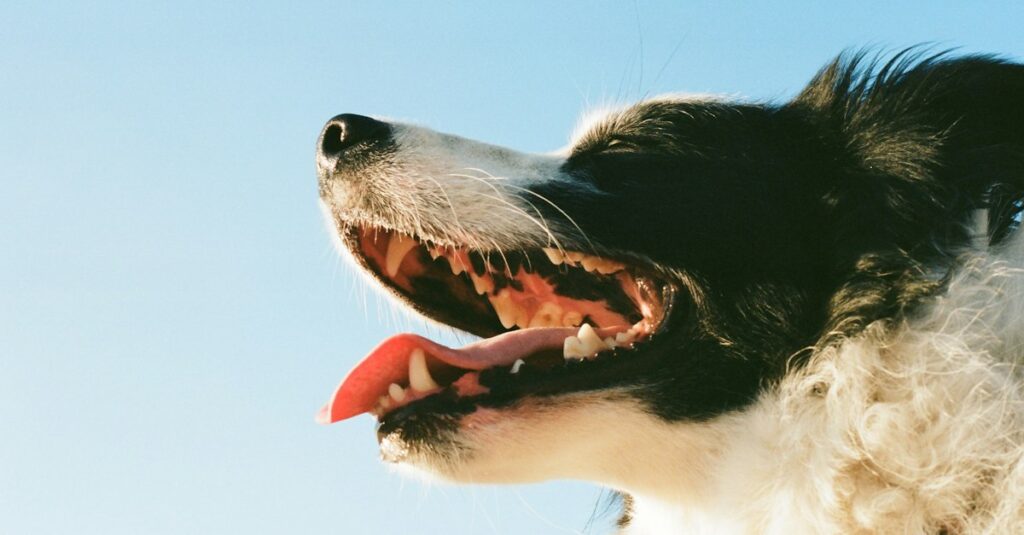
This dog dental chart outlines the name, number and job of each individual tooth located inside a dog’s mouth, for adult dogs as well as puppies. Puppies have 28 baby teeth while adult dogs have 42 permanent teeth. Clicking on any single tooth on the chart below will allow you to view the actual name of the tooth, how many roots it has, and at what age it comes through. Or enter the age of your puppy and you will receive information regarding which teeth should currently be present.
Most of the charts available online are simply pictures. There is nothing wrong with this, until your veterinarian states that tooth number 108 has a “slab fracture”, or your five-month-old puppy appears to have two canine teeth on one side of its mouth. At that point you want to know which tooth they are talking about and if it is important. The chart here follows the same numbers as those written by your veterinarian on your dog’s dental record; therefore, you can follow along.
Interactive Dog Dental Chart
Switch between the adult and puppy charts, then tap any tooth.
Tap a tooth to see its name, number and details. The chart is drawn as if you are facing the dog, so the dog’s right side is on your left.
Tooth numbers follow the modified Triadan system used on veterinary dental charts. Eruption ages are typical ranges and vary with breed and the individual dog.
Dog Dental Chart: The 42 Adult Teeth
| Tooth type | Upper jaw | Lower jaw | Total | Triadan numbers | Main job |
|---|---|---|---|---|---|
| Incisors | 6 | 6 | 12 | 101 to 103, 201 to 203, 301 to 303, 401 to 403 | Nibbling, scraping, grooming |
| Canines | 2 | 2 | 4 | 104, 204, 304, 404 | Gripping and holding |
| Premolars | 8 | 8 | 16 | 105 to 108, 205 to 208, 305 to 308, 405 to 408 | Cutting and shearing |
| Molars | 4 | 6 | 10 | 109 to 110, 209 to 210, 309 to 311, 409 to 411 | Crushing and grinding |
| All teeth | 20 | 22 | 42 |
The lower jaw has two more teeth than the upper jaw, as it carries an extra, third molar on both sides. These two small teeth at the very back of the lower jaw, numbers 311 and 411, are easy to miss when looking in a dog's mouth, and they are typically among the first teeth lost to gum disease.
How many roots does each tooth have?
| Tooth | Upper jaw | Lower jaw |
|---|---|---|
| Incisors and canines | 1 root | 1 root |
| First premolar | 1 root | 1 root |
| Second and third premolars | 2 roots | 2 roots |
| Fourth premolar | 3 roots | 2 roots |
| First and second molars | 3 roots | 2 roots |
| Third molar | None in the upper jaw | 1 root |
How the Numbers on a Dog Dental Chart Work
Vets typically do not write "upper right fourth premolar" in their records. Instead they will utilize the modified Triadan system, which assigns each tooth a three-digit number. The first digit corresponds to the quarter of the mouth, with the last two corresponding to the position of the tooth (counted toward the back from the center of the front teeth).
| First digit | Quarter of the mouth (adult teeth) | Same quarter for puppy teeth |
|---|---|---|
| 1 | Upper right (100s) | 5 (500s) |
| 2 | Upper left (200s) | 6 (600s) |
| 3 | Lower left (300s) | 7 (700s) |
| 4 | Lower right (400s) | 8 (800s) |
So, for example, "01" will always be the incisor closest to the middle, and "04" will always be the canine (the pointy tooth). "09", then, is always going to be the first molar. The upper left canine is written as 204, the lower right first molar is written as 409, and a puppy's upper right baby canine would be 504. With that rule you can read any dog dental chart that a clinic gives you.
The Carnassial Teeth: The Four That Do the Heavy Work
Dogs possess four large "scissor" type teeth called carnassials, which work in two pairs. The two top carnassials (the upper right fourth premolar, tooth 108, and the upper left fourth premolar, tooth 208) slide down along the outside of their lower counterparts (the lower left first molar, tooth 309, and the lower right first molar, tooth 409). Carnassials are the largest cheek teeth in a dog's mouth, and it is common for dogs to turn their heads sideways in order to use these teeth while chewing.
They are also the teeth that cost owners the most money. A chew that is too hard (i.e. antlers, weight-bearing bones, hooves) can shear a flat slab from the side of the upper carnassial. When this break exposes the pulp, the root can become infected. The first time most owners will notice something wrong is when they see a swollen area just below the eye. Veterinary dentists have a helpful rule for which chews should be avoided: if you cannot dent it with your thumbnail, then do not give it to your dog to chew.
Puppy Dental Chart: The 28 Baby Teeth
| Baby tooth | Number per jaw | Total | Comes through | Falls out |
|---|---|---|---|---|
| Incisors | 6 | 12 | 3 to 5 weeks | 3 to 5 months |
| Canines | 2 | 4 | 3 to 6 weeks | 4 to 6 months |
| Premolars | 6 | 12 | 4 to 10 weeks | 4 to 6 months |
| Molars | 0 | 0 | Puppies have no baby molars | |
| All teeth | 14 | 28 |
Baby teeth get numbers in the 500s through the 800s, and there is a deliberate "skip" at 05 in that numbering. Since there are no baby versions of the first premolar or of any of the molars, the cheek teeth of a puppy get the numbers 06, 07 and 08, so that each one lines up with the adult tooth that will replace it. The adult first premolars and molars simply come up through empty gum, in the space that develops as the jaw grows longer.
Puppy Teething Timeline by Age
| Age | What is happening | Teeth in the mouth |
|---|---|---|
| Birth to 3 weeks | No teeth | 0 |
| 3 to 6 weeks | Baby incisors, canines and premolars come through | Up to 28 |
| 6 to 8 weeks | Full baby set is normally complete | 28 |
| 3 to 5 months | Baby incisors fall out, adult incisors come through | Mixed |
| 4 to 6 months | Adult canines and premolars come through. Heaviest chewing | Mixed |
| 4 to 7 months | Adult molars come through at the back | Rising to 42 |
| By about 7 months | All adult teeth in place | 42 |
If a baby tooth is still in place when the adult tooth beside it has started to come through, it counts as a retained tooth. The American Kennel Club advises telling your vet about any baby teeth that remain after six months, because they may need to be removed. Retained teeth are most common in toy and small breeds, and the canines are the usual culprits.
Teething is also when chewing and nipping are at their peak. That's why most of us end up searching for a teething chart at about four months. The chewing is normal, and it will pass. But whatever you teach during those weeks, your puppy will keep. Therefore, give your puppy something legal to chew on each time it grabs something that is not. See how to stop puppy biting and mouthing and our guide to puppy training toys.
How to Read Your Vet's Dental Chart
After a dental cleaning, most veterinary clinics will give you a copy of your dog's chart. The chart is essentially the same map of numbered teeth. The only difference is there will be an abbreviation or code written next to each tooth where there was an issue. Codes can vary slightly from one clinic to another, however the ones listed below are the codes that you are most likely going to encounter.
| Code | Meaning |
|---|---|
| PD1 to PD4 | Periodontal disease stage, from gingivitis only (1) to more than half of the tooth's support lost (4) |
| PP | Periodontal pocket, with the depth in millimetres |
| GR | Gingival recession: the gum has pulled back from the tooth |
| M1 to M3 | Mobility: how loose the tooth is |
| F1 to F3 | Furcation: bone lost between the roots of a multi-rooted tooth |
| T/FX | Fractured tooth |
| TR | Tooth resorption |
| CA | Caries, a true cavity. Uncommon in dogs |
| X, XS, XSS | Extraction: simple, with the tooth sectioned, or surgical |
| RCT | Root canal treatment |
| CI and GI | Calculus (tartar) index and gingivitis index |
Common Problems and Which Teeth They Affect
- Retained baby canines (504, 604, 704, 804): two teeth in one socket. Common in Yorkshire Terriers, Chihuahuas, Pomeranians and other toy breeds.
- Slab fracture of the upper carnassial (108, 208): caused by very hard chews. May show as a swelling under the eye.
- Crowded and rotated premolars: small and flat-faced breeds have the same 42 teeth in a much shorter jaw, so the teeth overlap and trap food.
- Worn incisors and canines: from chewing tennis balls, crate bars or stones.
- Missing first premolars or third molars: some dogs never grow them. Your vet can confirm with a dental X-ray that the tooth is truly absent and not trapped under the gum.
Gum disease is the most common dental problem of all. The American Veterinary Medical Association says that by the time a pet is three years old it will very likely have some early evidence of periodontal disease, which gets worse with age if nothing is done.
Dog Teeth Compared With Human Teeth
| Dog | Human | |
|---|---|---|
| Baby teeth | 28 | 20 |
| Adult teeth | 42 | 32 |
| Adult set complete at | About 7 months | About 12 to 13 years, or later with wisdom teeth |
| Shape of cheek teeth | Pointed, for cutting | Flat, for grinding |
| Cavities | Uncommon | Very common |
| Gum disease | Very common | Common |
As for dogs, they rarely develop cavities. Their teeth are pointed, their saliva is less acidic than ours, and they generally consume far less sugar. So what do dog owners need to worry about? Gum disease! It starts with plaque, which hardens into tartar in a very short period of time (days). Once tartar has formed, it causes the gum tissue to pull back from the tooth. And once this occurs, the bone that holds the root of the tooth in place is slowly lost.
Getting Your Dog Used to Having Its Teeth Checked
The value of a dental chart comes from being able to actually see your dog's teeth. Most dogs do not enjoy having their lips lifted, and it is best that your dog learns to accept this as a young puppy. Begin in the first week at home by touching the muzzle with your hand, lift one lip for just one second, give a treat, and then stop. Continue this pattern and build upon it for a couple of weeks, until you are able to examine both sides of your dog's mouth and run a finger along the gum line.
- Lift the lip at the side first. The front teeth are the most sensitive, so leave them until last.
- Add a finger brush or soft toothbrush with dog toothpaste. Never use human toothpaste, which can contain ingredients that are toxic to dogs.
- Brush the outer surfaces of the upper teeth, where most tartar builds up. Thirty seconds a side is enough.
- Finish with a reward every time, so that the toothbrush predicts something good.
- Once a month, compare what you see with the chart: count the teeth, and look for red gums, brown tartar, chips or a tooth that has changed color.
For chews and dental diets, look for the Veterinary Oral Health Council (VOHC) seal, which is given only to products that have shown in trials that they reduce plaque or tartar. A dog that is relaxed about mouth handling is also far easier to examine at the clinic: see ways to reduce stress during vet visits.
Related Reading
- How to Stop Puppy Biting and Mouthing
- Best Puppy Training Toys Guide
- Puppy Vaccination Chart
- Dog Years Calculator
- Senior Dog Care Tips for First-Time Owners
FAQs
How many teeth do dogs have?
Adult dogs have 42 teeth: 12 incisors, 4 canines, 16 premolars, and 10 molars. There are a total of 20 teeth in an adult dog's upper jaw and 22 in the lower jaw. All breeds of dog develop the same number of teeth, regardless of how large or small they grow, from a Chihuahua to a Great Dane. Some individual dogs, however, are missing a few.
How many teeth do puppies have?
Puppies have 28 baby (deciduous) teeth: twelve incisors, four canine teeth and twelve premolars. There are no baby molars. By the time puppies are six to eight weeks old, they will typically have a complete set of baby teeth. Between around three and seven months of age, this baby set is replaced with their permanent (adult) teeth, which number 42.
When do puppies lose their baby teeth?
Puppies begin to lose their baby teeth at around three months, starting with the incisors at the front. The canines and premolars are replaced when they are approximately four to six months old. By about seven months most puppies have all of their permanent teeth.
What do the numbers on a dog dental chart mean?
These are called Triadan numbers. The first digit tells you which quarter of the mouth the tooth is located in: 1 is the upper right, 2 is the upper left, 3 is the lower left and 4 is the lower right. The next two digits count the teeth on that side, starting from the front. Therefore 04 will ALWAYS be a canine tooth, and tooth 304 is the lower left canine.
What are the carnassial teeth in dogs?
There are four of what we call "carnassial" teeth, two of them located on top (the upper fourth premolars) and two on the bottom (the lower first molars). The numbers for these teeth are 108, 208, 309 and 409. These are the largest of a dog's cheek teeth, and they function as scissor blades to cut food. They are also the teeth most often broken when a dog chews something very hard.
Do small dogs have fewer teeth than big dogs?
No. A small dog has the same total number of teeth (42) in a much smaller jaw space, which means the teeth will frequently be crowded or rotated. Because of this crowding, the gums begin to develop problems earlier. In some cases, especially in dogs with shorter muzzles and flatter faces, a few premolars or the last molars are missing. This is not a rule for the breed; it is simply an example of how individual dogs differ from one another.
Is it normal for a puppy to swallow its baby teeth?
Yes. Most of the time a puppy swallows the baby tooth along with its food, or while chewing on something. The tooth passes through and swallowing it is not harmful. This is the reason that many owners never find one. You might also see a tiny bit of blood on a chew toy when your puppy is teething; that is normal.
Sources
- Merck Veterinary Manual: Dentition and dental nomenclature of animals
- American Veterinary Dental College: Nomenclature
- dvm360: Identifying problems early in a puppy or kitten mouth (eruption ages)
- American Kennel Club: Timeline of puppy teething
- American Veterinary Medical Association: Pet dental care
- Veterinary Oral Health Council: Accepted products